By Michael A. Cone
In 1895, the West Kootenay was booming. Mines high in the mountains around Rossland, Ymir, Nelson and the Slocan were flourishing and on the shores of Kootenay Lake small mining camps were popping-up everywhere with newspaper reports of promising new discoveries. On Kootenay Lake, Nelson and Kaslo were leading the way. They were alive with the sounds of construction, as wood frame buildings were erected along their busy main streets and a chorus of train and steamer whistles echoed off the mountains announcing arrivals and departures. At Nelson, where the foundations for the new Hall Mines Smelter were being excavated, merchants aspired to make their town the commercial center of the region, while Kaslo saw itself as the gateway to the rich silvery Slocan.
At the time, two steamboat companies were in competition for the passenger and freight business between Nelson and Kaslo. Nelson was the headquarters for the Columbia & Kootenay Steam Navigation Co. (C.& K.S.N.), which operated steamers on Kootenay Lake as well as the Arrow Lakes. Kaslo also had its own navigation company, smaller in size but with a pretentious name, the International Navigation & Trading Company (I.N. & T.) In the fall of 1895, both companies owned one steamer each on the Lake; the C.& K.S.N had the Nelson and the I.N. & T had the Alberta. The Nelson’s busy timecard saw her leave Nelson for Kaslo three days a week and twice weekly for Bonner’s Ferry, while the Alberta left Kaslo for Nelson daily, except Sunday. Running in opposite directions, the two steamers rarely had an opportunity to race, but they were rivals, and if they happened to catch one another at an opportune time, they wouldn’t hesitate to take one another’s measure in a contest. The Nelson was considered the faster boat, but since there was plenty of business to go around, being known as the ‘flyer’ didn’t matter a great deal. However, all this was about to change.
In the fall of 1895, the C.& K.S.N began construction of a new steamer especially for the Nelson – Kaslo route. Designed by the Company’s Manager, Captain James W. Troup, the new boat was larger than the Nelson and featured many design elements not found on any other steamer on the lake. Troup’s reputation as a daring white-water Captain from the lower Columbia River, and his proven skill as a capable and innovative steamboat designer, preceded him. In the trim new steamer, Troup replicated many of the hallmarks found on the fast, express steamers legendary on the lower Columbia, including a hull modelled for speed, with its straight bow stem, its fine lines forward, and a delicate wine-glass shaped transom. The new boat’s well-proportioned superstructure featured a Saloon deck (Passenger deck) with an extended forepeak, which allowed passengers to sit or stand over the bow. As a final touch, the wheelhouse eaves were trimmed with decorative fretwork. Equipped with second hand engines salvaged from the charred remains of the Company’s Arrow Lake steamer Columbia, the new steamer was launched at Nelson in April of 1896 and was christened Kokanee.
The Kokanee wasted little time in showing her heels to I.N. & T.’s Alberta. After giving the Alberta a half-hour head start at Kaslo, the Kokanee gained on her prey and then passed her, reaching Nelson with a convincing lead of ten minutes. According to the Nelson paper, The Miner, the Kokanee’s time, including stops at Ainsworth and Pilot Bay, was “2 hours and 55 minutes.” It was an impressive showing and since she had swept the competition aside, a whisk broom was rightfully tied to her wheelhouse flagstaff.
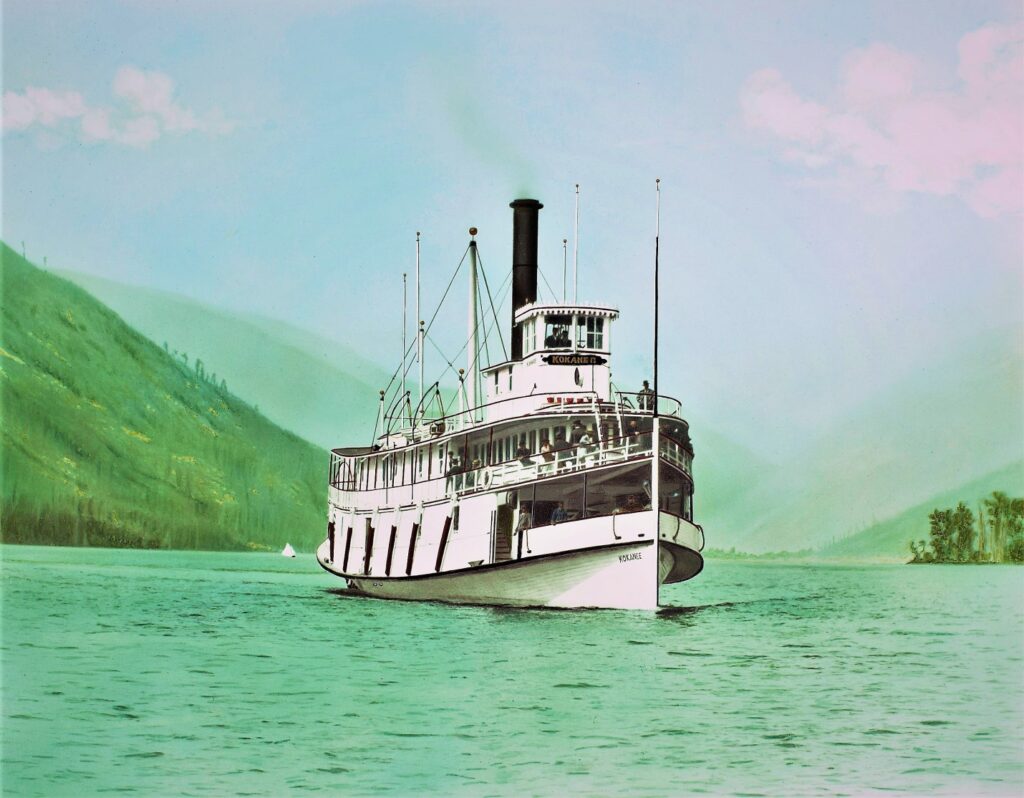
The Kokanee approaching the Nelson City wharf –circa 1896.
Meanwhile, George Alexander, the General Manager of the I.N. & T., was not troubled by the Alberta’s poor performance. She was not considered a fast boat anyway and besides, he was busy making arrangements to build a new steamer of his own to compete directly against the speedy Kokanee. According to Alexander, his new ‘flyer’ was “specially designed for speed and in graceful beauty and elegance of appointment she will surpass any boat now on Kootenay Lake”.
Like the Kokanee, whose hull frames were cut at the coast and transported by rail to Nelson, so too were the hull frames for the I.N. & T.’s new boat. Unfortunately, very little is known about where her frames were cut (some accounts suggest Puget Sound but a more likely location was Portland) and who actually designed and built her. Her Registry identifies James Carson of Kaslo as the builder but Louis Paquet, a well-known shipbuilder from Portland, was probably the shipwright responsible. Interestingly enough, the new boat taking shape at Kaslo was virtually identical in size to the Kokanee. Both were 142 feet long, plus or minus a few inches, and both had widths of 24 feet, again within inches of one another. (In comparison to the Moyie, which arrived two years later, these steamers were 20 feet shorter and 6 feet narrower). When the new I.N. & T. steamer was nearing completion, the Kaslo newspaper, The Kootenaian, in its enthusiasm prematurely said the new boat would be named The City of Kaslo, but because there was already a tug on the Lake with the name Kaslo, the name chosen was International.
While the Kaslo newspaper was overzealous in naming the new steamer, their prediction revealed the deep sense of civic pride that surrounded the new boat. While her speed was certainly important, the fact that she was built locally was foremost in importance. The same was true with the Kokanee. Nelsonites were every bit as proud and supportive of the C.& K.S.N as the good people of Kaslo were of the I.N. & T. In the same vein, the editors of each town’s newspapers took every opportunity to laud their favourite boat to the skies and rebut their rival. The extent of their bias was clear as the International was nearing completion and interest deepened in her particulars compared to those of the Kokanee. Every last detail concerning each boat was closely scrutinized in the press. Both had identical boiler capacity, the length of the International’s engine stroke was one inch less than that of the Kokanee’s, but then again, the Kaslo Kootenian pointed out, “engineers described the International’s engines as being vastly superior to those of the Kokanee”, and besides which, the paper said, “her wheel is larger by about three feet, than that of the C.& K. boat”. The reference to having superior engines was because the Kokanee’s engines were older and had poppet valves. The International’s gross tonnage was considerably more than the Kokanee’s at 525 tons verses only 348 tons. But the International had lighter draft, drawing only 3 1/2 feet of water, whereas the Kokanee drew a full 4 feet. This, it was said, was due to the Kokanee’s hull being doubled framed and the International’s hull single framed.
By the time the International was ready for her trial runs at the end of October, speculation as which boat was faster had reached an unprecedented pitch. That speculation included sizeable wagers being placed in every bar in Nelson and Kaslo, and as far away as Rossland, Vancouver and Spokane. When the I.N. & T. decided to show off their new boat to the people of Nelson, they offered a free excursion to Balfour and back. According to the Nelson Miner, although there was a lot of praise about the International’s accommodations and her comfortable furnishings, the majority of Nelsonites remained “true to their first love, the Kokanee.” The paper observed that even though conditions were unfavourable for the International to make a good showing, many passengers kept a close eye on their watches and the shoreline to gauge her speed relative to the Kokanee’s and that the “general impression” was “they would be pretty evenly matched.”
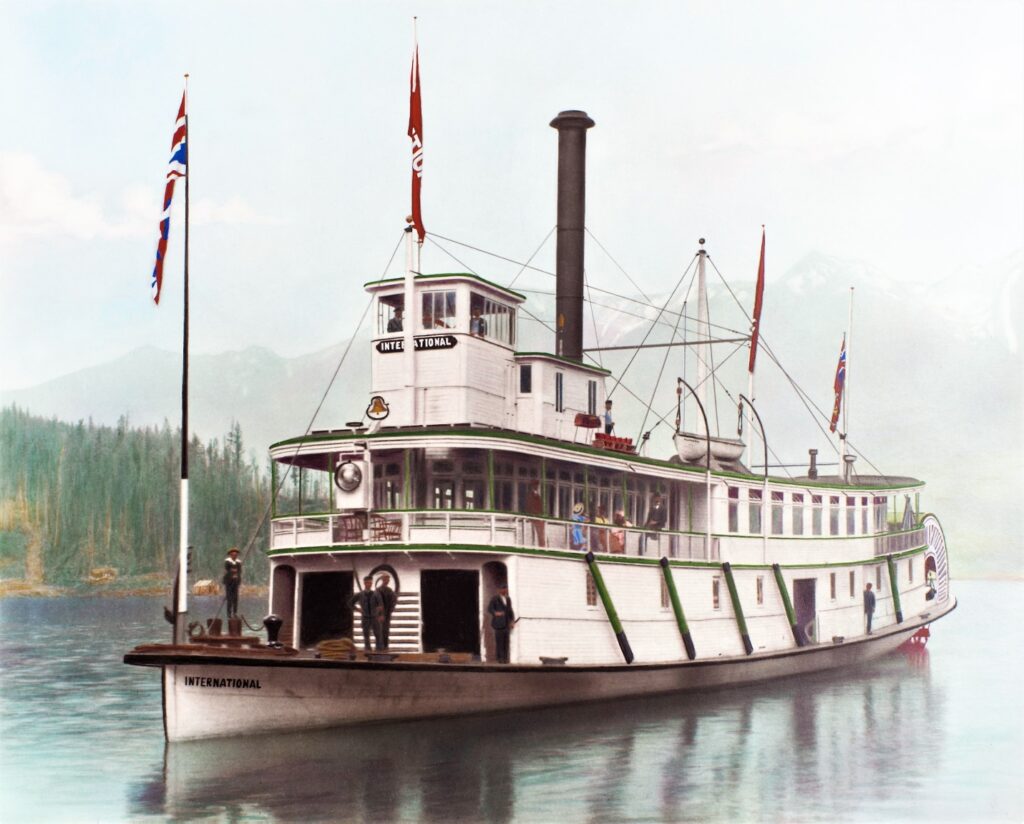
The International in Kaslo Bay.
The one intangible that tipped the scales in the I.N. & T.’s favour was the universal popularity of the International’s skipper, Captain George Hayward. He was well-known in both towns, having come to Kootenay Lake in the late 1880’s as Master of the little screw-steamer Galena. Later he worked for the C.& K.S.N as Captain of the Nelson before being hired by George Alexander to command the Alberta. In all fairness to the Kokanee’s master, Captain Daniel McMorris, he too was well-liked, but not to the same extent as Captain Hayward.
With both steamers assigned to the Nelson-Kaslo run, but running in opposite directions, it took a few weeks before the two met. The Kokanee drew first blood, beating the International in a race from Five-Mile Point (known today as Troup,named after Captain Troup) to Nelson. Winning by nearly a quarter mile, the Nelson paper proclaimed that the Kokanee should still wear the broom, but George Alexander cried foul. He said it was not a race since the International was still breaking-in her engines and was running under reduced steam pressure.
A couple of weeks later, the two rivals met again in another contest from Five-Mile Point, the steamer landing for the Great Northern’s Nelson & Ft. Sheppard Railway, to Nelson. This time the International won, and the Nelson Miner had no choice but to admit that she was now entitled to wear the broom and it “should be bigger than a whisk broom.” In their defense, the paper claimed, the Kokanee “people say their boat was very heavily ladened and not in fit condition to race.” Regardless, the race generated “much excitement and shouting” in the streets and no doubt a lot of money changed hands that day. But, what everyone really wanted was for the two steamers to square-off in a long race from Nelson to Kaslo.
Instead of one contest to settle the question of speed supremacy on the Lake, the two rivals engaged in short “hammer and tongs” battles at favourable moments. In their next meeting a few weeks later, they raced from Ainsworth to Kaslo. The International slipped away from the Ainsworth dock ten minutes ahead of the Kokanee, but by the time Kaslo was reached, the Kokanee had shaved 3 minutes off her rival’s lead. The newspaper correspondent who covered the race for the Spokane Chronicle newspaper wrote: “So it looks like the Kokanee won’t have such a picnic as they thought running away from the new boat.” A few weeks later, they raced again from Five-Mile Point to Nelson. Describing this race, the Nelson Miner said “There was a good deal of excitement in town, as the news spread that the boats were racing.” Continuing on, the paper observed that “Crowds of people assembled at all the various points of vantage” to watch the contestants. With the International enjoying a slight lead at Anderson Point (the present site of the Nelson Bridge) her Captain veered hard to port and cut across the Kokanee’s path, forcing the trailing steamer to plow through her wash. The Kokanee made a last minute spurt but it wasn’t enough and the International reached the City wharf first, but only by a length. Antics like this were a part of racing. There were no rules and Captains did whatever they could to win, everything from trying to keep their opponents in shallow water to waiting patiently to catch their foe at the slightest disadvantage. Officers and crews were intensely loyal to their ships.
The following year, in 1897, the rivalry and jockeying for wins continued unabated. In late January the two archrivals sparred again on the long, open stretch from Ainsworth to Kaslo. This time, the International left Ainsworth first and then waited for the Kokanee to catch up. Once the two were abreast of one another, the race was on. The International finished first with a comfortable one mile lead. Three months later, the two met again, but this time they raced from Five-Mile Point all the way to Kaslo, making quick stops along the way at Pilot Bay and Ainsworth. With their engines exhausting heavily and steam and smoke belching from their stacks, they attracted crowds of onlookers at each stop. The Kokanee left her rival in her wake, but as one newspaper correspondent in Ainsworth observed about those who rushed aboard at Ainsworth to witness the finish, “it is safe to say that a more excited and enthusiastic crowd never boarded either boat before.”
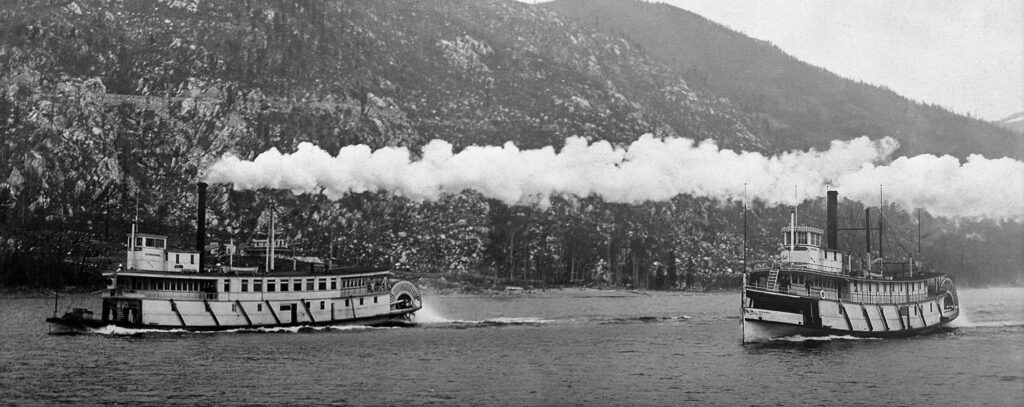
The International (left) and the Kokanee (right) battling it out on the West Arm shortly after leaving Nelson. The shoreline visible between the two steamers is Bealby Point. Photograph courtesy of the Kootenay Lake Archives.
The year 1897 ended with an unexpected twist. At Kaslo, the officers of the Kokanee hosted a New Year’s Eve bachelor dinner banquet aboard their boat. Invited guests included non-other than the officers of the International and Alberta, plus some Kaslo businessmen. The Kokanee’s dining saloon was festively decorated for the occasion and after a scrumptious dinner, which included shelled oysters, filet of beef with mushrooms and young turkey with jelly, toasts were made to the Queen, Our Guests, Kootenay Lake steamers, Kaslo, and so forth. If anyone thought the banquet was intended to “bury the hatchet”, they were mistaken. Later that spring, the two were at it again, this time on the course from Five-Mile Point to Nelson. According to Captain McMorris, the International waited deliberately for two hours for the Kokanee to arrive, but when it was over, the Kokanee reached Nelson first, sporting a half-mile lead. The next day, the Kokanee proudly displayed the whisk broom on her flagstaff when she docked at Kaslo. Captain McMorris stepped briskly ashore and had this to say about his adversary, “We have beaten her now three times in succession and I shall carry the broom until she compels us to lower it.” Not surprisingly, the International’s skipper, Captain Matthew Reid, downplayed his colleague’s remarks, saying the International hadn’t been waiting and that she was running on low steam pressure, and he emphasized, “We have beaten them before and can again, if necessary.”
While this would not be the last time the two rivals would tangle in what looked suspiciously like racing, events in 1897 and 1898 dulled the competitive temperament of their rivalry. Two new players, the Canadian Pacific Railway and the Great Northern Railway acquired control of the small independent C.& K.S.N. and I.N. & T. companies in an effort to consolidate their rail and steamer connections in the Kootenays. The first corporation to be acquired was the C.& K.S.N., who sold to the CPR effective February 1st, 1897. The following year, George Alexander disposed of his controlling interest in the I.N. & T. to the Great Northern, who would henceforth operate the International under a subsidiary company called the Kootenay Railway & Navigation Co.
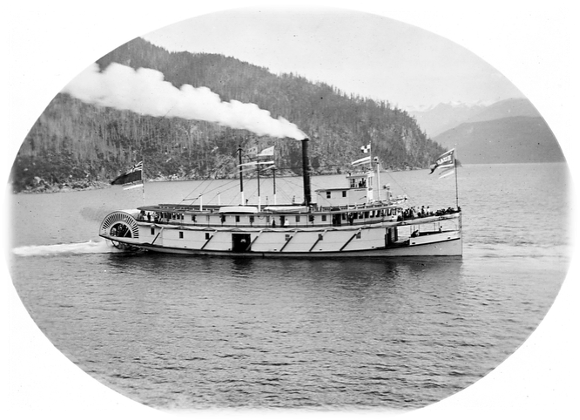
The Kokanee leaving Kaslo Bay, likely bound for Dominion Day celebrations at Nelson.
Racing aside, the Kokanee and International were both favourites when it came to excursions. Kaslo’s big day was Queen Victoria’s birthday (May 24th) and both steamers, decorated with flags and evergreen bunting and carrying a brass band on board, handled capacity crowds of excursionists to Kaslo for the round trip fare of $1.50 per person, children $1.00. Dominion Day was Nelson’s day of celebration, and once again both were on hand to bring throngs of holiday visitors to the city for two days of sports and festivities. They were also chartered for other excursions as well, especially during the pleasant summer months of July and August. In those halcyon days, excursions were often organized under the auspices of fraternal groups, like the Independent Order of Odd Fellows (I.O.O.F.), or by churches for Sunday School picnics and sometimes by the steamship companies themselves.
The two warriors continued to operate on the Nelson-Kaslo run until they were replaced by larger and faster steamers. The International was succeeded by the big Kaslo in 1901 and was later withdrawn from service in 1908 pending repairs to her firebox. She ended her days abandoned on the shore of Riondel’s Galena Bay and her hulk was finally burned in the early 1950’s. The Kokanee enjoyed a longer career on the Kaslo run, being replaced by the Kuskanook in 1913. She was retired in 1923 and after being stripped of her machinery and valuable fittings, was sold. She left Nelson under tow (the first time ever) and was taken to a private landing called Deanshaven, located south of Riondel, where she was to be used as a hunting lodge. The venture failed and the old ‘flyer’ was eventually dismantled and her hull scuttled. Ironically, the finally resting places for the two archrivals were less than a mile apart.
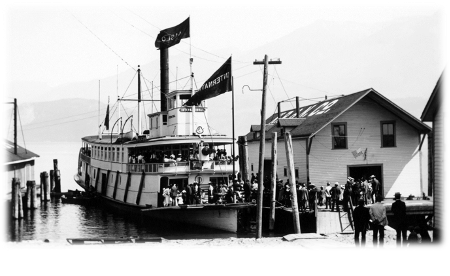
Crowds of excursionists dressed in their best attire boarding the International at Kaslo’s 3rd Street wharf, near where the Moyie rests today. The wharf shed on the left belongs to the CPR, while the one on the right is owned by the Kootenay Railway & Navigation Co.