By Michael A. Cone
The deep-seated rivalry between the CPR’s Kokanee and the GN’s International took on a different tone after the turn of the century. This change followed the International’s owners adding another steamer to its fleet. That impressive steamer was the Kaslo, the largest and most luxuriously appointed sternwheeler yet to appear on the Lake. Launched at Mirror Lake on September 17, 1900, she was not intended to replace the International on the Nelson-Kaslo route, rather, she was built to handle passenger traffic between Kaslo and the east shore town of Kuskonook.
Kuskonook was the railway terminus for the Great Northern’s new railway from Bonner’s Ferry. The section of track from Bonner’s Ferry to the US border was called the Kootenai Valley Railway, and the portion of the line extending north from the border to Kuskonook was the Bedlington & Nelson Railway. At Kuskonook, where there was a train station, turntable and water tower, connection was made with the steamer from Kaslo.
Built from hull frames cut at the renowned Portland, Oregon,shipyard of John F. Steffen, the Kaslo was rumoured to have been modelled after the fast lower Columbia River steamer Hassalo (second of that name). In charge of construction was Master builder Harold Elliott, a former partner in the Nelson boatbuilding firm of Elliott & Hale. It was said that when the keel was being laid, a major miscalculation was made in setting its length. That mistake resulted in the keel being a full 10 feet shorter than specified. Consequently, when it came time to fit the hull frames to the keel, there were some frames left over. This also meant that the frames positioned nearest to the bow, which were the last ones to be fitted, had to be recontoured to conform to the ship’s blunter bow. Not only did these ad hoc modifications leave the Kaslo with a bluff bow instead of the sharper prow her model had called for, they also caused her bow to ride high in the water, like an empty barge. To remedy this problem and achieve proper trim, tons of concrete were poured down into her forward hold as ballast.
Despite these flaws, the Kaslo was a striking example of a typical Pacific Northwest sternwheeler. Her hull was deep, with round bilges and a high sheer, qualities aimed at comfort and safety in rough water. Her well-proportioned superstructure had clean, sweeping lines, which included the open, extended forepeak, found only on the best Columbia River excursion steamers and on the dashing little Kokanee as well. The Kaslo’s wheelhouse was distinctive. A few other steamers on the Lake had curved wheelhouses, but the Kaslo’s was set-off with decorative panelling. Inside her Saloon deck, staterooms featured hot and cold running water, a luxury not found on any of the CPR boats. Located amidships, her alcove-shaped saloon was bright and airy. Here, passengers seated at large rectangular tables were surrounded by walls panelled in carved mahogany with mirror inserts and transoms accented in ground glass relieved with photographic transparencies of local scenes. Along the portions of the outside walls that extended the full width of the deck were large plate-glass windows that offered unobstructed views of the passing scenery. She had 10 staterooms and was licensed to carry 500 passengers. Her powerful machinery was ordered from the Polson Iron Works in Toronto. Ironically, the Polson yard had a strong affiliation with the CPR, and it supplied boilers and engines for many of the CPR’s inland lake steamers.
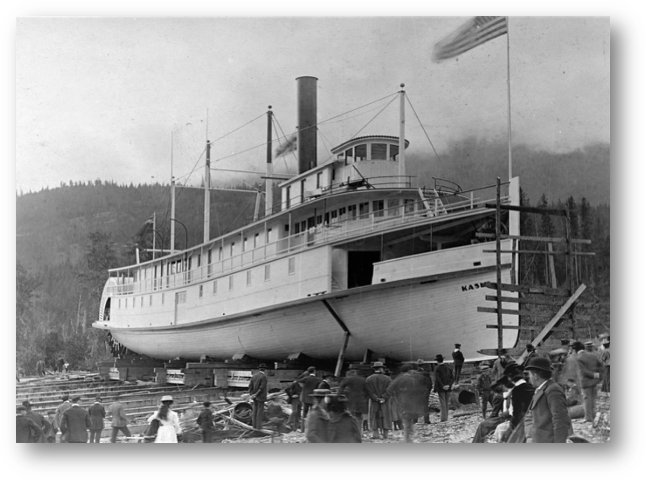
The Kaslo on the launching ways at Mirror Lake moments before sliding down into the water.
A few weeks after the Kaslo was launched, the Nelson Tribune was already fueling speculation about the new steamer’s speed, saying that steamboat “men are awaiting with interest the appearance” of the new K.R. & N. ‘flyer’. The “Kokanee is admitted to be the fastest all around steamer on Kootenay lake” opined the paper, and it is “expected that a lively brush will ensue between her and the Kaslo…” once the latter’s machinery is broken in. Unfortunately, a race would have to wait. In mid-November, a fierce winter snowstorm caused havoc with steamship operations on the Lake. The Kaslo was tossed hard onto a sandbar near Redman’s Point, north of Kuskonook, and despite efforts by the CPR steamer Nelson to free her, she remained stuck overnight. She did manage to free herself next morning and was able to make it back to Kaslo. That same night, the CPR’s Moyie was also caught in the blizzard while heading back to Nelson from Kootenay Landing. She was driven against the rocks on the West-shore, leaving her with two holes punched in her hull. With waves crashing over her bow and using her pumps and a crew-manned bucket brigade, she headed into the teeth of the storm. She made Procter safely that night, and after transferring her passengers to the waiting train, continued on to the Nelson shipyard.
Rail and steamer service on the fast new Kuskonook route commenced on November 25, 1900. From Sandon, GN trains rumbled down the mountains to Kaslo in time for passengers to board the Kaslo ready for her daily morning run to Kuskanook. Connection was made at Pilot Bay with the K.R. & N.’s International working between Nelson and Kaslo. The Kaslo would remain at Kuskonook until the arrival of the northbound train before returning to Kaslo late in the afternoon. From Kuskonook, train service to Spokane was also daily. Advertised as the “fastest, most direct” timecard from Sandon through to Spokane, the entire journey took 12 hours, which shaved almost 19 hours off the best travelling time offered by the alternative GN route to Spokane from Kootenay Lake. This older route was the Spokane Falls & Northern and Nelson & Fort Sheppard rail lines that had its steamer connection at Five-Mile Point. Given the time savings between the two routes, the future of the Kuskonook route seemed assured.
With the Kaslo and Kokanee maintaining separate schedules, leaving Kaslo and returning later in the day, it seemed unlikely that the two rivals would be squaring-off any time soon. More by happenstance than design, they clashed earlier than expected. The Kokanee drew first blood by beating the Kaslo in a race from Woodbury Creek to Kaslo. The victory prompted the Nelson Tribune to proclaim that she “is still queen of the lake in point of speed.” But, the Kaslo Kootenian reported that the contest was “not a fair test” explaining that the Kaslo’s smoke box had become clogged and that she lost steam pressure. Four days later, they raced again, but this time over three short courses all on the same day. The first encounter started in the West Arm and ended at Pilot Bay, with the Kaslo winning. Then, after giving the Kokanee a short head start, the Kaslo beat her to Ainsworth. The last encounter was from Woodbury Creek to Kaslo, with the Kaslo carrying off the honours for the third straight time. Winning in such a convincing fashion led the Kaslo Kootenian to declare “the steamer Kokanee is no longer Queen of the Lakes.” Commenting on the win, Nelson Tribune reported that the Kaslo’s crew was emphatic, claiming “their boat is faster than anything else on the lake, which they are ready to demonstrate whenever occasion offers.” Even the Bonner’s Ferry Kootenai Herald, a loyal supporter of the GN, had something to say, writing that the town of Kaslo “nearly went wild over the affair.”
Despite the racing spirit that was percolating, there were no further contests for several months. Then, towards the middle of May, with Victoria Day celebrations fast approaching, the K.R. & N. saw an opportunity to show off their new boat to the people of Nelson. Chartered by the I.O.O.F., the special excursion included stops at Kaslo, Lardo (also spelt Lardeau) and Argenta. On board was the popular Rocky Mountain Rangers Band. Newspaper advertisements read: “RIDE ON THE BIG BOAT AND RIDE FAST.” Fares were $1.80 return, children half price. As for the CPR, they were caught off-guard. They didn’t have a sponsor, nor did they have a band. In a last-minute effort to draw attention away from the Kaslo excursions, the CPR arranged for the Moyie to make four round trips to Kokanee Creek under the auspices of the Knights of Pythias. The CPR also tried to downplay the likelihood of the Kaslo and Kokanee racing by making it clear in the press that “there was no truth in the report that passengers will be given the spectacle of a 50 mile race between the rival boats.” But it was too late.
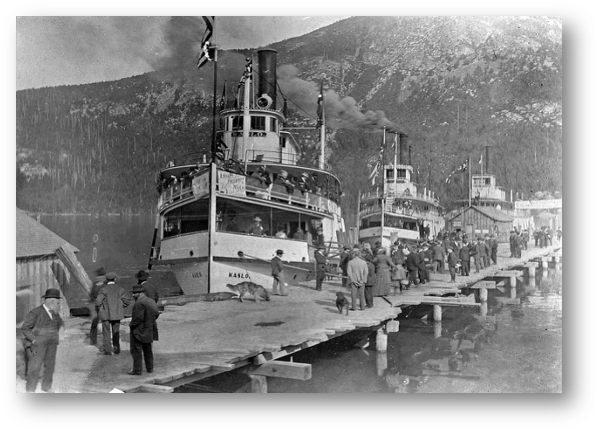
The Kaslo, Kokanee and Moyie at the Nelson city wharf shortly before departure time. The Kaslo and Kokanee were heading to Kaslo while the Moyie was taking excursionists to a different location.
On what would turn out to be a picture-perfect spring day, the Kaslo arrived at the Nelson city wharf first sporting I.O.O.F. posters and flying an assortment of port-of-call banners. It was her first appearance in Nelson. She was soon joined by the Kokanee and later by the Moyie. The Kokanee left first, backing away with 100 excited excursionists on board. The Kaslo followed a few minutes later, packed with 300. The Kaslo’s Captain was in no hurry and he gave the Kokanee a good five-minute head start before ringing “full ahead”. With the band playing on the hurricane deck and everyone crowding the starboard rails, the Kaslo caught the Kokanee and then passed her. The GN boat held the lead the rest of the way, and she reached Kaslo half-an-hour ahead of her opponent. It was an exciting start to the day. Unfortunately, it was also the last time these two rivals – or any other CPR and GN steamers for that matter – would challenge one another in a sprint over a course as long as the one from Nelson to Kaslo.
In an interesting turn of events, while the Kaslo’s decisive victory over the Kokanee that day earned her the prized set of antlers, but for some reason, she never wore them on her wheelhouse eaves for all loyal and opposing partisans to see.
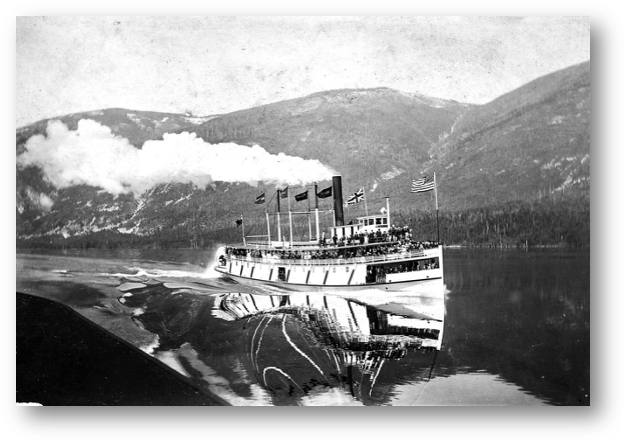
In a spectacular photograph taken from the top deck of the Kokanee, showing the Kaslo cutting the calm water of the West Arm as she gains on her rival. She would go on to win the Victoria Day contest.
The Kaslo remained on the Kaslo-Kuskonook run for only a few more months. The highly touted service was a financial failure from the outset for the Great Northern. Facing mounting losses, the Company cancelled the steamer service in early September 1901, and soon afterwards regular trains were discontinued along the Bedlington & Nelson section of the line. Left at a loose end, the Kaslo took over the International’s run between Nelson-Kaslo, in direct competition with her archrival, the Kokanee.
With both steamers now on the same run and both running in the same direction, the stage was set for some lively skirmishes. Newspapers were keen on reporting outcomes, especially if their favourite boat won. Crews were unwavering in their loyalty and at times bullish in their affirmations, which added to the drama. The most popular course continued to be the straight stretch from Five-Mile Point to Nelson. Inbound for Nelson, there were no stops beyond Five-Mile Point. This was the last stop for the K.R. & N. boats, and it was an ideal spot to stage a race from, since it offered a clear view of steamers approaching, so it gave the K.R. & N. steamers a clandestine reason for waiting as freight was being unloaded until a rival was close at hand. Also, the first one to tie-up at the Nelson City wharf was the undisputed victor, with everyone in town watching the outcome. One thing rival Captains watched for was the amount of ore his opponent was carrying. As a general rule, the Kaslo carried one or two, sometimes more, carloads of ore down from Kaslo. These were offloaded at either Five-Mile Point or Nelson. On the other hand, the Kokanee tended to come down with a much lighter load, which was always unloaded at Nelson. Catching an opponent with a heavy load was an opportunity to be exploited.
A good demonstration of the racing prowess and heightened crew antics between the Kaslo and Kokanee occurred in January 1902. That month, the two rivals raced twice inbound from Five-Mile Point. The Kokanee won the first contest, although according to the Nelson Daily Miner, the “officers of the Kaslo did not feel justified in putting their boat at racing speed” because they were loaded and the Kokanee was running light. No doubt provoked by unfair tactics on the part of the Kokanee, the Captain of the Kaslo waited a few days before exacting his revenge.
That day, just as the Kaslo was pulling away from the landing at Five-Mile Point, the Kokanee was spotted steaming down the lake. The Kokanee turned and made a stop at Six-Mile wharf, but rather than wait for his opponent to catch up, the Captain of the Kaslo made his intentions clear by reversing all the way back to where the Kokanee was docked and waiting out in the channel for her opponent to leave. The Kokanee accepted the challenge, and by the time the two steamers passed the buoy at Five-Mile Point, they were abreast of one another, and, according to the Nelson Daily Miner, “both in good racing trim.” Before long however, the Kaslo forged ahead, and from then on it was more like a procession than a race. At one point when the Kaslo was ahead, one of her officers actually climbed up onto the steamer’s paddlewheel cover and dangled a rope over the end, so as to offer the trailing Kokanee a tow. At the City wharf, the Kaslo’s crew upped the ante by telling the Nelson Daily Miner that “they were offering to wager $1,000 or any less sum that the victory can be repeated at will.”
The CPR was undoubtedly irked over the Kaslo’s ownership of the prized deer antlers and the apparent ease with which she seemed to be able to show her heels to the smaller Kokanee. For Captain John C. Gore, who had succeeded Captain J.W. Troup as Superintendent of the CPR’s BC Lake & River Service, headquartered in Nelson, this roused his ire. But, there wasn’t much he could do to humble his taunting rival other than to keep the two apart, especially during the highly popular Victoria Day holiday excursions to Kaslo. This he did by scheduling the Kokanee to leave Nelson at different times than the Kaslo or by having the Kokanee make extra stops along the way.
In 1905, the CPR announced its intention to build a fast, new express steamer to replace the Moyie on the daily run between Nelson and Kootenay Landing. Kootenay Landing was the Company’s mainline rail terminus at the south end of the Lake, just inside the mouth of the Kootenay River. Passenger traffic along the CPR’s Crow’s Nest Pass line had increased steadily since it was completed in 1898, and by 1905, passenger demands for stateroom cabins were greater than what the Moyie could handle.
Like Captain Troup, Captain Gore’s early experience was on the Columbia River, and its tributaries, and he too was intimately familiar with the dimensions and stylings of the best express steamers running on the river. In designing the new steamer, speed was important because of her mainline rail connections at both Nelson and Kootenay Landing. Her sleek hull measured 193.5 feet in length, with a beam of 30.9 feet. Compared to the Kaslo, the new CPR boat was over 20 feet longer and almost 5 feet wider. Her large locomotive boiler and her powerful engines were ordered from Polson Iron Works, the same yard that had equipped the Kaslo. In addition to speed, passenger accommodations were also a priority. With the Kokanee, Moyie, and Kaslo, all of their lounges and staterooms were located on a single deck, whereas with the new CPR flagship, these accommodations were found on two decks. All told, the new steamer boasted 37 staterooms, with a total of 74 berths. Other amenities included an extra observation lounge aft on the upper deck (or‘texas’deck), writing areas with desks and a grand staircase connecting the two decks.
Launched at Nelson in May 1906, the new CPR steamer was christened Kuskanook. To allow everyone in town the opportunity to attend the launching, a half-day Civic Holiday was declared. The launching ceremony itself was flawless, but there was one frustrating moment for spectators watching the proceedings from the Moyie. Just as the Kuskanook started gliding down the ‘ways’ and into the water, the Kaslo, which was also carrying a crowd of anxious onlookers, drifted right in front of the Moyie, blocking the view of those on board. The consensus was that the new pride of the CPR fleet presented a striking appearance on the water and her accommodations were modern, comfortable and inviting, but could she beat the Kaslo.
Unexpected delays in the arrival of her furnishings fueled rumours in both Nelson and Kaslo that there were problems with the Kuskanook’s machinery. But the rumours were groundless. On one of her trail runs, she paced the Kokanee. As one observer aboard the new ‘flyer’ said “it looked like the Kokanee was moored to her dock”.
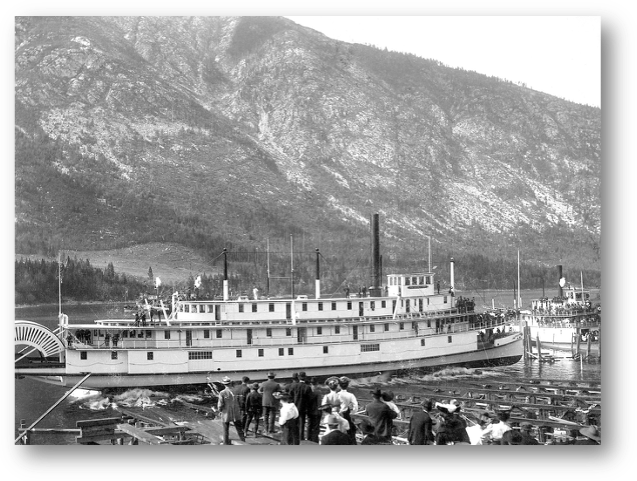
The launching of the Kuskanook at Nelson on May 5, 1906. On the right is the Moyie.
No one was more anxious for a decisive test of speed against the Kaslo than Captain Gore. He waited patiently for just the right time, and that day came shortly after the Kuskanook had passed her Steamship Inspection. Familiar with the Kaslo’s schedule, Captain Gore let it be known that the Kuskanook was going to deliver a carload of oats to Lardeau. According to the Nelson Daily News, he also said that the Kuskanook “would like the Kaslo’s company part of the way”. As planned, the new flagship waited for the Kaslo at Procter. From there, she followed the GN boat over to Pilot Bay, where the Kaslo completed her stop. Idling out in the Lake, the Kuskanook then gave the Kaslo a sizeable lead as she headed for Ainsworth before giving chase. Springing to life, the Kuskanook was at full speed in no time, and it wasn’t long before the new ‘flyer’ was whistling to pass the old ‘flyer’. In the Kuskanook’s wheelhouse, Captain Gore looked on with satisfaction as the Kuskanook left the Kaslo trailing in the new boat’s wake. In describing the race, the Daily News said that “those who claim to know say the Kuskanook can beat the Kaslo a mile in every six” and “it is semi-officially declared that the new boat can make 22 miles an hour when she is asked to do it.” Of course, not everyone agreed. The Captain of the Kaslo told the Nelson Daily Canadian that he was “taken by surprise and was unprepared for a race and was adamant that if given another chance, “the older steamer can show her stern paddle wheel to the lookout man of the Kuskanook.”
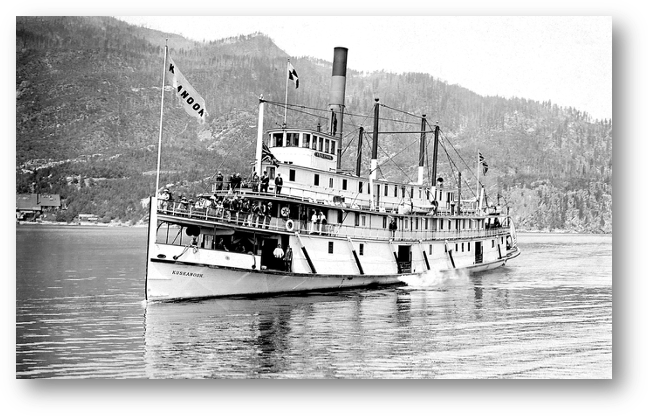
The CPR’s Kuskanook entering Kaslo Bay, most likely on a Victoria Day excursion. Note the antlers on her wheelhouse eave.
Rhetoric and partisanship aside, there was no doubt that the speed laurels belonged to the Kuskanook. From that day on, she rightfully wore the prized deer antlers on the eave of her wheelhouse, and she never relinquished them throughout her 25-year career. The antlers were still proudly displayed when she was retired by the CPR in 1931. The skirmish that took place with the Kaslo that day in July 1906, was more than a victory for the CPR. It was, for all intents and purposes, the last genuine race between the CPR and the Great Northern steamers on Kootenay Lake.